ByJohn A
Under $2,000: Is a Prosumer Espresso Setup Worth the Investment?
For years, setting up a serious home coffee bar under $2,000 meant making hard sacrifices. Either you spent your entire budget on a standalone dual boiler machine and settled for a mediocre grinder, or you bought a great grinder and paired it with a single boiler unit that made steaming milk a slow, tedious chore.
Today, prosumer hardware is reshaping expectations. Upgrading to a prosumer level setup under $2,000 gives you commercial brewing mechanics—like dual boilers, PID temperature control, and quiet rotary pumps—without forcing you to compromise on grind quality or counter space. The question is no longer whether prosumer performance is worth it, but how to get the most value out of that budget.
Meraki
The Real Cost of a Prosumer Espresso Setup
When calculating the cost of a high-end espresso station, beginners often forget that a machine is only half the equation. To pull true café-quality shots, your budget usually needs to cover:
- The Espresso Machine: A dual boiler or heat-exchanger unit providing thermal stability and high-pressure steam.
- A Specialized Espresso Grinder: Fine, stepless adjustment capabilities to dial in bean extraction.
- Precision Measuring Tools: A fast digital scale for weighing coffee doses and monitoring shot yield in real time.
Meraki - Barista Accessories: Calibrated tampers, distribution tools, dosing funnels, and milk pitchers.
Meraki
Purchasing these items separately can easily push a $1,500 machine budget well past $2,500. This hidden total cost is why integrated, high-performance systems have become so popular for home kitchens.
See also: A Buyer’s Guide to Navigating Goodark’s Semiconductor Product Catalog
The Integrated Advantage: All-in-One Prosumer Performance
Traditionally, “all-in-one” coffee makers carried a reputation for subpar grinders and cheap single-boiler construction. However, modern engineering has completely changed the landscape.
When evaluating options for a complete espresso machine under $2000, single-unit systems now deliver genuine commercial hardware. Having dual boilers means you can extract espresso and texture milk at the exact same time without dropping pressure. Meanwhile, incorporating a rotary pump ensures stable 9-bar pressure with whisper-quiet operation—a massive upgrade over the loud, vibrating buzz of budget appliances.
Meraki+ 2
Integrated systems also solve the clutter problem. By embedding a dedicated grinder and gravimetric dual scales directly into the chassis, you eliminate messy cords, separate scales, and crowded countertops while keeping recipe variables fully visible.
Meraki
Workflow and Repeatability: Turning Good Shots into Routine
The biggest difference between consumer appliances and prosumer equipment is repeatability. A basic machine might pull a great shot occasionally by sheer luck, but temperature drift and inconsistent grind sizes make repeating that success nearly impossible.
Prosumer equipment focuses heavily on workflow precision:
- Dose Control: Grinding by weight ensures the exact same mass of coffee enters your portafilter every morning.
Meraki - Thermal Lock: PID temperature controllers continuously monitor boiler heat, keeping water locked to your target temperature throughout the extraction.
Meraki - Yield Management: Gravimetric brew scales automatically track output in the cup, stopping the shot precise to the gram so your espresso never tastes over-extracted or sour.
Meraki
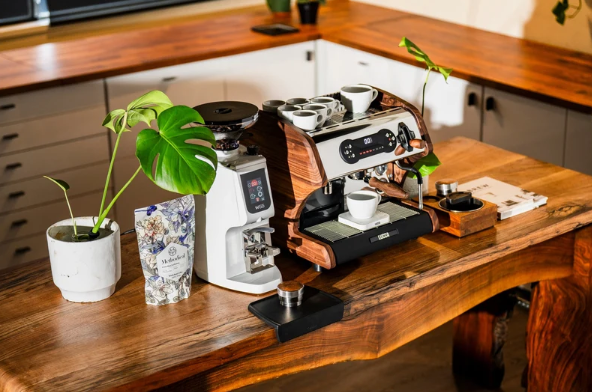
For enthusiasts looking for an all-in-one setup that combines commercial-grade dual boilers, an integrated grinder, and automated scale controls, the Meraki Espresso Machine offers a streamlined, professional workflow designed specifically for home kitchen counters.
Meraki
What to Keep in Mind Before Buying
Before committing to a $2,000 setup, evaluate how you drink coffee daily:
- Drink Preferences: If you almost exclusively drink milk-based beverages like lattes, flat whites, or cappuccinos, the instant steam power of a dual boiler system will dramatically improve your routine.
- Ease of Use: Advanced hardware offers precision, but intuitive touchscreen interfaces or automated gravimetric stop settings help reduce the learning curve for family members who just want a quick cup.
Meraki - Maintenance & Water Quality: High-end machines feature brass, copper, and stainless steel internal components. Using filtered, scale-free water is essential to protect your investment for years to come.
Final Thoughts
Is a prosumer espresso setup under $2,000 worth the investment? For anyone who values daily consistency, quiet operation, and café-quality microfoam, the answer is a resounding yes. By bringing dedicated dual boilers, commercial pump mechanics, and built-in weight measurement into a unified setup, modern prosumer equipment removes the frustration from home brewing—delivering an effortless, elevated coffee experience every single morning.