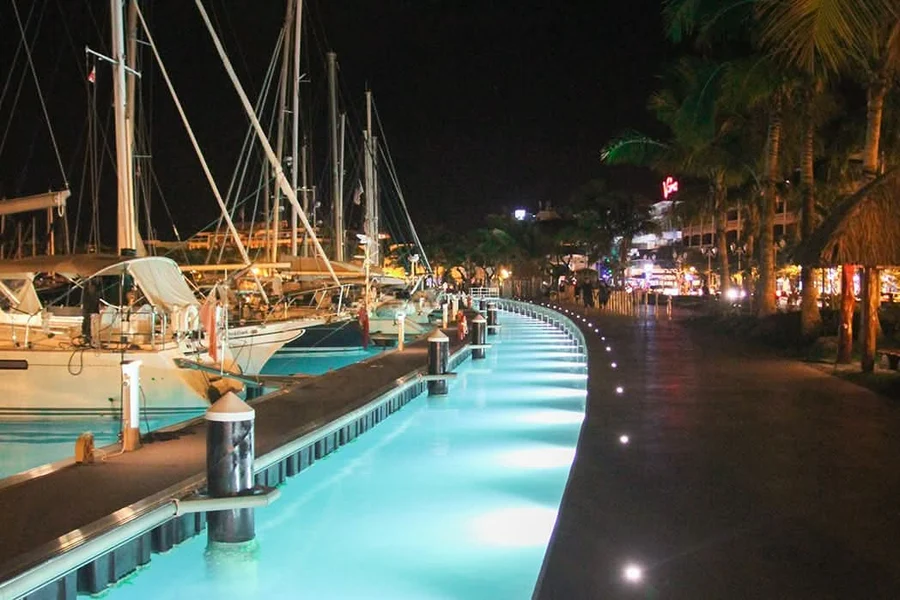

Marinas remain active after sunset, with boat owners returning from evening trips, staff checking berths, and visitors moving between vessels and shore facilities. Above-water lighting helps illuminate walkways and access points, but it cannot reveal every part of the water surrounding a dock.
Underwater dock lighting adds another source of illumination near the waterline. Depending on water clarity, fixture placement, and light output, it can make the area around a vessel easier to observe while creating a distinctive appearance after dark.
These lights should complement appropriate dock illumination, navigation lights, and safe boating practices. Their usefulness depends on the conditions at the site and the tasks they are intended to support.
Improving the View Around Berths
Dark water can make it difficult to distinguish floating debris, nearby objects, and the position of a vessel’s hull. Underwater lighting can reveal some of these features by directing light into the water near the dock.
The distance that light travels depends heavily on water conditions. Clear water generally allows better visibility than water containing suspended sediment, algae, or other particles. Boat movement and strong currents can stir up material that reduces clarity.
Mounting depth and beam direction also influence the illuminated area. A fixture placed behind part of the dock structure may have its beam obstructed, while a poorly aimed light may illuminate only a small patch of water.
A suitable arrangement should reflect the depth, width, and layout of the berth. Marina operators can assess common vessel movements and identify areas where additional illumination may be useful.
Underwater lights cannot reveal every submerged obstacle, so boat operators must continue to navigate cautiously and follow applicable safety requirements.
Supporting Movement Around Boats and Docks
Underwater lighting can provide an additional visual reference around the hull, helping people recognise the general position of a vessel in relation to nearby berths. This may be useful when returning to a marina in the evening or carrying out routine checks around a moored boat.
However, underwater lights do not provide enough illumination for every dockside task. Walking surfaces, ladders, steps, and mooring equipment require suitable above-water lighting.
A coordinated lighting plan can assign different functions to different fixtures. Piling cap lights can mark dock boundaries, pathway lighting can illuminate walking routes, and underwater lights can provide additional illumination near the hull.
Brightness needs careful control. Very bright fixtures can create strong reflections and make it harder for people to see beyond the illuminated area. Lights directed toward approaching vessels may also distract operators.
Testing the lighting from both the dock and the water can help identify glare and dark spots before the installation is completed.
Choosing an Appropriate Underwater LED Fixture
LED technology is commonly used for underwater marine lighting because it can provide useful light output with relatively low power consumption. Fixtures are available in different colours, brightness levels, beam patterns, and mounting styles.
The right product depends on the intended application. A small private berth may require only modest illumination, while a larger marina may need multiple fixtures to cover several docking areas.
White light is often selected for general illumination, while blue and other colours may be chosen for decorative purposes. The best colour for a particular installation depends on the water conditions, surrounding lighting, and desired appearance.
Compare actual light output, beam angle, power consumption, housing materials, and approved installation depth. A fixture intended for transom mounting may not be suitable for direct installation on a dock structure.
The product should also be rated for the conditions it will experience. General outdoor lighting should not be installed underwater unless the manufacturer explicitly approves that application.
Water Clarity and Placement Make a Difference
Underwater lighting behaves differently from lighting in open air. Water absorbs and scatters light, while suspended particles can reflect light back toward the source. This scattering may create a cloudy appearance instead of revealing objects farther away.
Increasing brightness does not always improve visibility. In turbid water, a more powerful fixture can increase backscatter without providing a clearer view.
Installation depth, angle, and distance from nearby structures should be assessed together. The best location depends on the dock’s design, water depth, changing water levels, and the manufacturer’s instructions.
Fixtures should be securely mounted and positioned to reduce glare for boat operators and people using the dock. Cable routing must also protect the installation from abrasion, vibration, and accidental contact.
For larger projects, testing a small number of fixtures before purchasing the complete system can help determine which output and placement work best under local conditions.
Energy Consumption and Operating Expenses
Marina lighting may remain switched on for several hours each evening. Efficient equipment can therefore help control electricity consumption, especially across sites with many berths.
LED fixtures generally consume less power than many traditional light sources for comparable output. Their rated operating lives may also reduce the frequency of light-source replacement, although drivers, seals, and other components can still require maintenance.
The total project cost includes more than the lights. Mounting hardware, electrical supplies, installation labour, protective equipment, and future servicing all contribute to the overall expense.
Compare fixtures using their stated power consumption and light output rather than wattage alone. A well-positioned light may provide more useful coverage than a higher-powered fixture installed at an unsuitable angle.
Professional installation can also reduce the risk of wiring faults, damaged seals, and incompatible electrical components.
Marine Protection and Installation Requirements
Underwater dock lights must be designed for the depth and environmental conditions of the installation. A fixture rated for rain or splashing should not be assumed suitable for continuous immersion.
Check the manufacturer’s immersion limits, temperature range, mounting instructions, and service requirements. Saltwater installations need particular attention to corrosion resistance, while freshwater sites may experience mineral deposits and biological growth.
The housing, lens, mounting hardware, and cable connections all contribute to long-term reliability. A well-sealed fixture can still fail if water enters through a damaged cable entry or unsuitable connector.
Permanently installed underwater lighting should use equipment approved for the application and comply with relevant electrical regulations. A qualified professional can assess the power supply, protective devices, and installation method.
Maintenance for Consistent Illumination
Underwater fixtures may accumulate algae, mineral deposits, and marine growth that reduce their output. Regular inspection helps identify buildup before it significantly affects performance.
Depending on the product, maintenance may involve cleaning the lens, checking mounting hardware, inspecting the housing, and examining accessible cables and connectors. Some fixtures can be serviced in place, while others must be removed from the water.
Always isolate the electrical supply before servicing and follow the manufacturer’s safety instructions. Lifting the fixture out of the water may be necessary for a thorough inspection.
Marina managers can include underwater lighting in their scheduled maintenance records alongside walkway lights and other electrical equipment. Recording faults and replacement dates helps identify recurring problems.
Lighting That Respects the Surrounding Environment
Underwater dock lighting can add visual interest and provide additional illumination around berths, but excessive artificial light may disturb aquatic wildlife and affect neighbouring properties.
Use brightness levels appropriate for the site, direct beams toward the intended area, and follow local rules governing waterfront illumination. Decorative lighting should not interfere with navigation or be mistaken for required vessel lights.
A balanced arrangement combines underwater illumination with properly positioned above-water fixtures. This allows marina operators to address different visibility needs without relying on one type of light to perform every function.