ByJohn A
A Buyer’s Guide to Navigating Goodark’s Semiconductor Product Catalog
Navigating an extensive electronic component portfolio can be daunting for procurement specialists, hardware architects, and component engineers alike. With thousands of discrete part numbers spanning various package sizes, breakdown voltages, current capacities, and automotive qualifications, finding the exact semiconductor device for a specific power stage requires a structured selection strategy.
Good-Ark Semiconductor manufactures a vast range of discrete devices designed for power conversion, signal switching, and circuit protection. Whether sourcing components for high-volume consumer adapters, industrial motor controls, or automotive-grade subsystems, understanding how to filter, evaluate, and source from the catalog ensures faster design cycles and robust supply chain resilience.
Understanding the Catalog Structure and Product Hierarchy
When sourcing components, the first step is understanding how product families are categorized based on function, power level, and silicon architecture. Good-Ark organizes its portfolio around primary discrete categories, making it easier to drill down to specific engineering requirements.
- Diodes and Rectifiers: Spanning general-purpose rectifiers, low VF Schottky barriers, fast-recovery diodes (FRDs), and zener diodes designed for power rectification and voltage regulation.
- Bridge Rectifiers: Integrated single-phase and three-phase rectifier packages ranging from low-profile surface-mount units (ABS, DB) to high-power through-hole modules (GBJ, KBPC).
- Power MOSFETs and Transistors: Trench low-voltage MOSFETs, high-voltage superjunction devices, and small-signal transistors tailored for high-efficiency switching and synchronous rectification.
- Circuit Protection Devices: Transient Voltage Suppression (TVS) diodes, ESD arrays, thermistors, and chip fuses engineered to clamp grid surges and electrostatic discharges.
Engineers and buyers can review the full range of available device families directly within the comprehensive Goodark product catalog to cross-reference primary parametric specifications.
Deciphering Electrical Specifications for Component Selection
Selecting the right device goes beyond matching basic part numbers; it requires aligning key electrical limits with the operating conditions of your circuit.
Rectifier and Diode Parameters
When filtering through semiconductor diodes, focus on three primary metrics:
- Peak Repetitive Reverse Voltage (VRRM): The maximum instantaneous reverse voltage the diode can withstand. Always select a VRRM rating at least 20% to 50% above the peak expected circuit voltage to allow a safety margin against inductive transients.
- Average Forward Current (IF(AV)): The continuous forward current the device can handle under defined thermal conditions.
- Forward Voltage Drop (VF): Lower VF reduces internal conduction power losses (Ploss=IF×VF), making Schottky diodes with low forward drops ideal for battery-powered or high-efficiency designs.
Switching Speed and Reverse Recovery (trr)
For high-frequency switch-mode power supplies (SMPS), standard rectifiers generate excessive switching losses during turn-off transitions. Fast-recovery and ultra-fast recovery diodes minimize reverse recovery time (trr), preserving overall system efficiency in high-frequency flyback or forward topologies.
Protection Component Parameters
For TVS diodes, pay attention to the Reverse Standoff Voltage (VRWM)—the maximum voltage at which the device remains inactive without conducting—and the Clamping Voltage (VC), which defines the peak voltage allowed through to downstream sensitive ICs during a high-energy surge event.
Navigating Package Options and Thermal Management
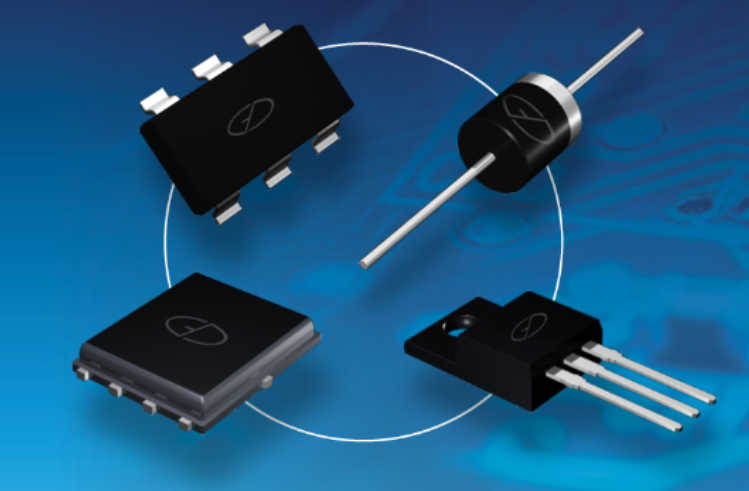
A silicon die’s real-world current capability depends heavily on its packaging. Good-Ark offers discrete components in surface-mount, through-hole, and bare die formats to accommodate varying space and thermal demands.
| Package Type | Typical Profiles | Primary Application Features |
| Surface Mount (SMD) | SMA, SMB, SMC, SOD-123, DFN/QFN | Compact footprints, low parasitic inductance, ideal for automated pick-and-place high-volume manufacturing. |
| Power SMD | DPAK (TO-252), D2PAK (TO-263) | Higher current handling with direct thermal pads for PCB copper heat spreading. |
| Through-Hole | TO-220, TO-247, ITO-220, DO-41 | High mechanical strength, low thermal resistance (RθJC) for direct attachment to external heatsinks. |
| Bridge Modules | ABS, KBP, GBU, GBJ, KBPC | Factory-matched multi-diode bridge configurations designed for space-saving mains AC-DC conversion. |
When selecting surface-mount parts for high-density boards, ensure your thermal copper pours around pads meet the datasheet’s minimum recommended layout dimensions to prevent localized thermal throttling.
Sourcing and Supply Chain Considerations for Buyers
For procurement teams, component selection involves evaluating lifecycle status, lead times, packaging formats, and quality certifications alongside technical parameters.
- AEC-Q101 Automotive Qualification: Automotive subsystems (CAN bus protection, onboard chargers, lighting drivers) demand components certified to AEC-Q101 standards, ensuring thermal cycling resilience and low PPM failure rates.
- Tape and Reel vs. Bulk Packaging: Surface-mount components are typically delivered on standard embossed tape-and-reel (T&R) formats optimized for high-speed automated assembly lines, whereas heavy through-hole bridges may be packed in tubes or trays.
- Cross-Referencing and Second-Sourcing: Good-Ark provides standard industry-equivalent part numbers (such as 1N4007, SMAJ series, or standard 2N/2N7002 transistors), simplifying drop-in replacements for existing designs without requiring PCB layout redesigns.
See also: Azure Cloud Security and DevOps Consulting for Modern Businesses
Final Thoughts
Successfully navigating Good-Ark’s semiconductor product catalog comes down to clearly defining your system’s electrical, spatial, and thermal boundaries early in the sourcing process. By systematically filtering parameters such as peak reverse breakdown voltages, forward conduction drops, switching recovery speeds, and package thermal resistances, design engineers and buyers can locate the exact discrete devices needed for their designs. Combining technical parametric matching with smart supply chain practices—such as verifying automotive AEC-Q101 qualifications and standard industry packaging—ensures high energy efficiency, reliable thermal performance, and long-term manufacturing stability for any electronic power stage.