ByJohn A
How Laser Engravers and Precision Turning Redefine Desktop Manufacturing
Desktop manufacturing has evolved far beyond basic 3D printing and crude woodworking setups. Modern makers, industrial designers, and small-scale fabricators now combine distinct digital fabrication technologies to construct high-grade functional hardware, custom assemblies, and consumer-ready products directly from a home workbench.
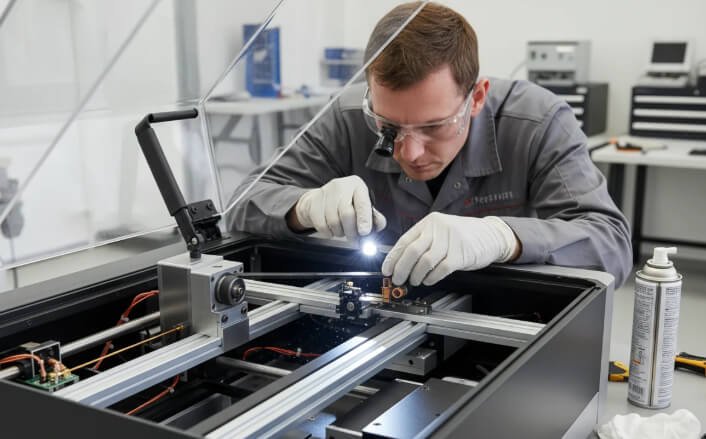
Two technologies leading this hybrid manufacturing shift are optical diode laser engravers and high-precision turning centers. By combining rapid 2D surface profiling with sub-millimeter cylindrical machining, makers can produce complex multi-material assemblies that rival industrial factory outputs.
The Dual-Engine Approach: Photonic vs. Mechanical Fabrication
Understanding how these two technologies complement each other requires looking at how they manipulate raw stock:
┌──> Thermal Laser Processing ──> Fast 2D Vector Cuts & Surface Etching
[Digital CAD/CAM Design] ─┤
└──> Mechanical Rotary Turning ──> Sub-Micron Precision Cylindrical Fits
- Photonic Thermal Cutting (Laser): Non-contact material processing using concentrated photon light. It excels at intricate vector profiling, rapid sheet slicing, and surface raster engraving without mechanical force or tool wear.
- Mechanical Subtractive Turning (Lathe/CNC): High-rigidity rotational cutting using carbide inserts. It shapes metals, polymers, and hardwoods into perfectly concentric shafts, bearing housings, and threaded fasteners.
See also: Azure Cloud Security and DevOps Consulting for Modern Businesses
Technology Breakdown: Lasers vs. Turning Centers
| Operational Aspect | Laser Fabrication Platform | Precision Turning Center |
| Material Axis Geometry | 2D Planar (X,Y axis travel) | Rotational / Cylindrical Axis (Z,X motion) |
| Primary Mechanism | High-energy focused light beam | High-RPM spindle with stationary tool bit |
| Target Stock Form | Flat sheets, panels, thin stock | Solid round bar stock, tubes, dowels |
| Material Strengths | Wood, acrylic, leather, coated metals | Aluminum, brass, stainless steel, dense plastics |
| Work Holding | Friction/gravity placement (no clamping force) | 3-Jaw / 4-Jaw chucks, collet closures |
The Precision Difference: Why Sub-Millimeter Fits Matter
While a 2D optical cutter shapes the structural housing, faceplates, or outer panels of a project, rotational mechanical parts require exact dimensional holds to function without friction, slop, or binding.
[Sheet Cut Panel (Laser)] + [Precision Turned Shaft (Lathe)] ──> Smooth Bearing-Mounted Rotary Unit
Using a high-performance laser cutting machine allows makers to rapidly produce outer enclosures, custom structural plates, and intricate mounting brackets. However, when those panels must house rotating drive shafts, motor couplings, or ball bearings, mechanical accuracy becomes paramount.
Achieving tight machining tolerances ensures that turned metal shafts fit into bearing inner races with exact press-fit or slip-fit clearances. Holding tolerances as fine as 0.005mm (5 microns) prevents axial runout and mechanical vibration, ensuring that desktop-fabricated hardware operates quietly and lasts under continuous mechanical load.
Real-World Applications of Hybrid Desktop Fabrication
Combining laser engraving/cutting with precision turning unlocks professional production capabilities across multiple industries:
1. Custom Robotics & Drone Assemblies
- Laser Work: Slicing lightweight carbon fiber or acrylic structural plates for chassis frames and arm mounts.
- Turning Work: Turning custom lightweight aluminum motor mounts, standoff spacers, and low-friction brass bushings.
2. Custom Mechanical Timepieces & Instrument Making
- Laser Work: Engraving high-contrast dial faces, custom leather watch straps, and wooden presentation boxes.
- Turning Work: Turning micro-bronze gear pivots, stainless steel watch cases, and winding stems to micron-level accuracy.
3. Audiophile Equipment & Custom Lighting
- Laser Work: Cutting wooden housing panels and laser-etching control panel labels or brand logos.
- Turning Work: Turning solid brass volume knobs, isolation feet, and threaded aluminum connector jacks.
Building a Complete Hybrid Workshop Strategy
To maximize productivity and ROI in a desktop manufacturing workflow, structure your hardware pipeline logically:
- Establish the Outer Form First: Use laser cutting for fast iteration on flat panel enclosures, structural frames, and decorative surface branding.
- Machining Functional Components: Use precision turning for core mechanical motion elements where cylindrical concentricity and press fits are required.
- Streamline Software Workflows: Standardize vector design files (SVG, DXF) for optical laser jobs, and use CAD/CAM toolpaths (G-code) for precision turning operations.
Integrating optical light cutting with sub-micron rotary machining provides desktop makers with a complete, end-to-end prototyping and small-batch production system right on their workbench.